

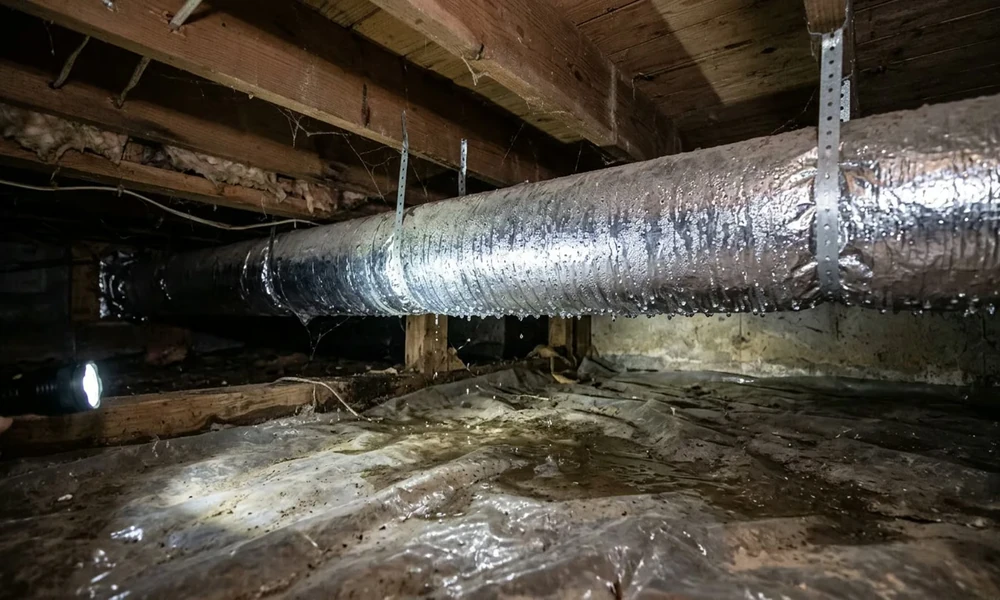
Georgia did something unusual in 2011. Starting that July, every new home in the state had to pass a pressure test showing its ductwork didn’t leak too much, and Georgia was the first state to make that mandatory. It was a real step forward, but it only covered homes built afterward. Nearly every house in Habersham County from before that summer has a duct system nobody has ever measured, and plenty of those systems lose a share of their heating and cooling under the floor before any of it reaches a room.
Getting someone to look at that hidden half of the system is easier than most people expect. Economy Heating & Air, an hvac company in Cornelia that has worked across Gainesville and northeast Georgia for decades, handles duct cleaning and indoor air quality alongside its repair, maintenance and installation work on furnaces, air conditioners, heat pumps and mini-splits. The company also cleans dryer vents. Since it covers the ductwork as well as the equipment, it’s in a good position to judge whether a comfort problem starts at the unit or somewhere along the path the air takes.
That path is the best way to understand what’s going on beneath the floor. Air leaves the living space through the return, goes through the equipment, travels down the trunk and branches, and comes back out the registers. Each stage has its own way of going wrong.
Where the Return Pulls From
The return side gets the least attention and causes some of the worst problems. Its job is to draw air from the house back to the equipment. In many older homes, though, the return was built from building cavities instead of real ductwork, using the space between floor joists closed off with a sheet of metal or panned underneath. Those cavities are rarely sealed, so the system ends up pulling air from the crawl space along with air from the hallway.
Crawl space air in Cornelia is damp, earthy and often musty. When it’s drawn in through the return, it carries moisture, dust and that basement smell straight into the bedrooms. A house that smells stale every time the system starts, but not otherwise, often has a return problem.
Inside the Air Handler and Plenum
The connection where ductwork meets the equipment is another weak spot. Plenums tend to separate over the years, especially where the original installer used cloth duct tape instead of mastic. Tape adhesive dries out in a few summers, and the seam slowly opens up. Southface, the Atlanta building science nonprofit that helped shape Georgia’s energy code, has long pointed to duct leakage as one of the largest energy losses in Southern homes. The code moved to requiring mastic for exactly this reason.
Along the Trunk and the Flex Runs
From the plenum, a main trunk carries air across the crawl space, and smaller flexible ducts branch off to each room. This is where things stretch, sag and come apart. Flex duct is easy to install and just as easy to damage. Over time it gets crushed by someone crawling to reach a pipe, pulled loose by a pest control tech, or sags between hangers until airflow slows to a trickle.
Clues that something along the way isn’t working usually show up inside the house.
- One room is always hotter or colder than the rest
- Weak airflow at a register even with the system running hard
- Dust collecting quickly despite regular filter changes
- Utility bills rising faster than the weather explains
- Musty odors when the system first starts up
In summer, a different problem shows up under the floor. Cold supply ducts running through humid crawl space air sweat like a glass of iced tea. If the insulation wrap is torn or missing, condensation drips onto the floor framing and the dirt below. Over time that feeds mold on the duct jackets and the wood around them. North Georgia’s humid summers make this a regular sight under older homes.
At the Register and the Rooms Beyond
Where each branch reaches the floor, a metal boot connects to the register. The gap between that boot and the subfloor is often left unsealed, so conditioned air leaks into the floor cavity instead of the room, and crawl space air can work its way back up. A bead of mastic or foam around each boot is one of the cheapest fixes in the entire system.
Rooms added onto a house over the years tell their own story. A sunroom or converted garage tied into a system that was never sized for it will almost always be uncomfortable. Extending ducts to it rarely solves the problem as well as a separate ductless unit does.
When Cleaning Helps and When It Doesn’t
Duct cleaning has a mixed reputation, partly because of the coupon-mailer specials that promise a whole house for a price that can’t cover real work. The National Air Duct Cleaners Association recommends cleaning when there’s an actual reason. That includes heavy dust that keeps coming back, pets, allergy or asthma sufferers in the house, recent renovation dust, or signs of pests or mold. A genuine cleaning uses negative pressure and agitation tools through the entire system, including the returns and the blower, not just a vacuum at the register.
Cleaning can’t fix a leak, though. Clean ducts that are disconnected still dump air into the crawl space. It makes sense to inspect and seal first, then clean if there’s still a reason to.
Dryer vents belong in the same conversation even though they aren’t part of the heating and cooling system. Long vent runs common in newer homes, especially ones going up through a roof or across a crawl space, collect lint that slows drying and creates a real fire risk. A dryer that takes two cycles to dry a load is usually telling you the vent needs attention.
Testing the System Instead of Guessing
The same pressure test that new homes have needed since 2011 can be done on any existing house. A technician seals the registers, pressurizes the duct system with a calibrated fan, and measures how much air escapes. The number turns a vague feeling about uncomfortable rooms into something specific. It also tells you whether sealing alone will fix things, whether some runs need to be replaced, or whether the system was never designed right in the first place.
For homes where the crawl space itself is the bigger problem, sealing and conditioning that space can bring the ducts inside the home’s thermal boundary, so small leaks matter far less. Whichever route makes sense, the first step is the one most older homes in the area have never had, which is someone actually looking under the floor and measuring what the system is losing.
