

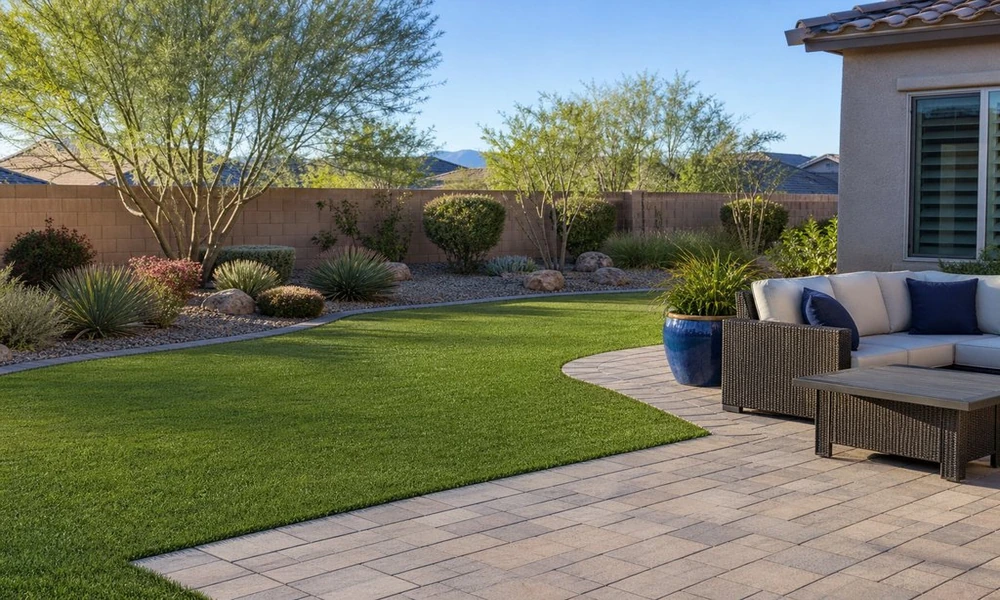
Think about how you’ll use the space. What are the activities you envision for your backyard? Do you want to have a backyard that is easy to maintain and just a pretty place to look at? Do you want a place for your kids and pets to play? Maybe you envision a patio for dining or a backyard for entertaining. Maybe you just want a space for you to unwind in the morning or evening.
Shape the Yard Around Daily Use
Break the space down into areas. A good designer breaks a space down into areas and considers how each area will be used. In a backyard this might look like:
- Turf area for play, pets or to soften the space
- Paver area for dining or seating
- Smaller areas along the perimeter for planting
- Circulation space, pathways from the house to gates, outbuildings, etc.
- Multi-use space, an area that can adapt to other uses as your needs change
Consider your options. In some situations a turf area is not necessary, for example if you’re designing a small entry courtyard. Other hardscape materials such as pavers or gravel, or loose elements such as containers and plants can provide interest and function to a space. However, in most Las Vegas backyards, a combination of turf and pavers, along with some perimeter planting areas, provide a nice balance of structure and softness. Too much hardscape in a backyard can feel unwelcoming and excessively hot, though cool-pavement strategies described at https://www.epa.gov/heatislands/using-cool-pavements-reduce-heat-islands may reduce heat buildup; too much turf can feel disjointed.
Think about function first. Consider where you’ll put the primary hardscape area, most likely a patio, and connect it with pathways to other destinations in the backyard. Avoid awkward, skinny areas that will be challenging to put furniture in or maintain. Make pathways large enough for their primary uses – especially if you expect to carry trays of food or drinks – and have Pure Turf and Hardscape map practical paver routes before installation. Consider how your patio relates to windows and doors, shade structures, and other elements on your property.
Choose and Install Turf Carefully
Keep your lawn simple. Turf areas that are broken up into too many different sizes and shapes can be more challenging to keep clean, particularly if there are lots of trees or planting areas where leaves, sticks, etc. will fall onto the turf.
Choose turf that fits your needs. There are a wide variety of turf products available today for Las Vegas homeowners. Some turf is intended to look more like a traditional lawn and others are designed with use in mind, such as pet turf or play turf. Consider:
- How much sun the space gets
- How the space will be used, including pets and kids
- How visible the seams will be from inside the house
- Whether or not you’ll be walking on it barefoot
Make sure your turf is properly installed. If the foundation is stable, the perimeter is restrained, and the transitions are detailed, synthetic turf can last for years and look great. If these details are missed, the turf can start to ripple, the edges can start to show, and the whole thing can start to look quite fake.
Where Will the Water Go?
Drainage is still important! Even in water-wise landscapes it’s important to make sure that water has somewhere to go, whether that’s rainwater, overflow from the hose, or roof drainage. Make sure that hardscape areas are sloped appropriately and that the foundation underneath synthetic turf allows water to infiltrate so it doesn’t pool. Depending on the space, it may be as simple as grading to an existing low spot or it could be as involved as needing a drain. Again, drainage isn’t always needed, particularly in small spaces that are already sloped and drain well, but it’s important to think about before laying down turf or pavers.
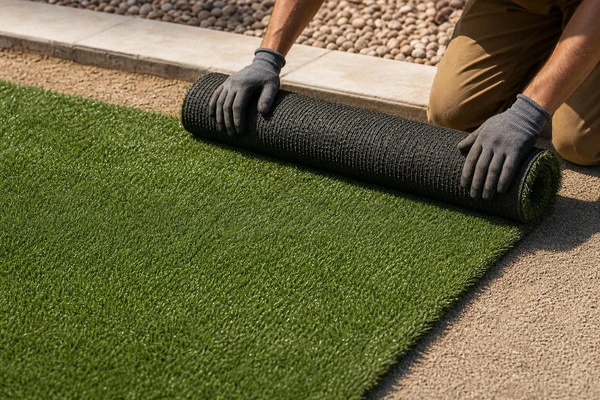
Consider planting areas. Planting areas can be helpful in breaking up hardscape areas and can help with slowing down or infiltrating drainage. Instead of lots of small areas scattered around, consider one or two strategic areas near patios or along perimeter areas.
Use Texture to Unify Materials
Play with scale and texture. In general, a consistent palette with a couple of contrasting elements will create a more cohesive landscape. Consider the color of your pavers and how it will relate to planters, walls, edging, gravel, furniture, etc.
Frame your turf. Turf looks best when it’s bounded by a crisp edge, whether that’s pavers, wood edging, or something else. Turf that transitions to another material in a random, uneven way can detract from the look of the lawn.
Simplicity rules. Too many different sizes, shapes, and textures can make a space feel busy. Consider a consistent hardscape material with limited plant selections and a well defined turf area.
Test the Layout Before Work Begins
Once you have a rough idea of where your patio, pathways, and lawn will go, walk around your space and visualize how it will function at different times of the day. Where will the shade be? Where will you put your furniture? How will you use the space? You can even sketch out your turf and patio areas on the ground with a stick or chalk and make adjustments accordingly.
